Maybe It’s Him?
When fertility treatment is focused primarily on the woman, it can be easy to overlook an obvious fact: if a man is contributing sperm to create the embryo, whether through natural conception, IUI or IVF, his health matters too.
This becomes especially important when couples are dealing with unexplained infertility, poor embryo development during IVF or early miscarriage. These outcomes may be influenced by sperm health and can have a male-factor contribution, even when a standard semen analysis appears normal.
If a man is contributing sperm to create the embryo, his participation in fertility care in the months leading up to conception may influence the chances of pregnancy and a healthy baby.
For decades, male fertility research focused on genes, hoping to find the hidden cause behind low sperm counts and unexplained infertility. According to reproductive urologist Dr. Paul Turek, that search turned up surprisingly little. What is explaining far more is sperm epigenetics, and the factors that shape it are ones men can actually change: what they eat, how they sleep, body weight, how they manage stress and what they’re exposed to every day.
In his recent ABORM Clinical Pearls talk hosted with Healthy Seminars, he offered a community lecture titled Sperm Matter! Beyond the Semen Analysis. Dr. Turek explained why he believes diet and lifestyle are key to improving sperm health and why that’s exactly why he loves traditional Chinese medicine (TCM). Here are the highlights, along with two short clips from the talk.
What is sperm epigenetics?
Your DNA is the instruction manual. Epigenetics are the marks on that DNA that help determine which instructions get read and when. They’re why a nose cell becomes a nose and not an eye, even though both carry the same genes. Dr. Turek describes epigenetics with a phrase he loves: “inheritance by experience.”
Unlike genetic mutations, which happen slowly from one generation to the next, epigenetic changes can occur in response to how we live. And because sperm are continually being produced, those influences may be reflected in the sperm a man produces.
Research presented in the talk links sperm epigenetic patterns to:
• Whether a man is likely to be fertile, even when his semen analysis looks normal
• Embryo quality and development
• Pregnancy and live birth rates with intercourse and IUI
• Paternal age, with sperm carrying a measurable “epigenetic clock”
This is one reason male fertility evaluation should not automatically stop when a semen analysis comes back within the normal range.
If a couple is experiencing unexplained infertility, embryos that repeatedly develop poorly or stop growing, or recurrent early pregnancy loss, it is reasonable to look more closely at the sperm side of the equation as well.
“Diet and lifestyle is the key”
Dr. Turek has spent his career studying sperm genetics, proteomics, transcriptomics and metabolomics in search of answers for men with low sperm counts and unexplained infertility. In this clip, he explains why he’s come to believe the real answer lies in diet and lifestyle and shares recent research on antioxidant vitamin therapy.
“We’ve done 30 years of heavy-duty genetics research and learned a little bit… Then we see things like diet and lifestyle making a big difference, and I’m realizing that’s where the answer is. It’s epigenetics, it’s diet and lifestyle. That’s what we have to work on. That’s the key.”
He also shared a recent case report of three men with low sperm counts whose sleep, stress, exercise and food were managed by an integrative team for about six months. All three saw their sperm counts rise, and all three couples conceived at home.
A case report isn’t proof, as Dr. Turek is quick to point out, but it illustrates why male preconception health deserves attention rather than treating sperm as simply a number on a semen analysis.
“This is why I love TCM”
When Dr. Turek lists what influences sperm epigenetics, the list will sound familiar to anyone who has seen a Traditional Chinese Medicine practitioner. It’s the same set of factors that affect overall fertility and the same ones holistic care has always focused on.
“This is why I love complementary medicine and traditional Chinese medicine, because it’s everything: what you eat, what you do, how you sleep, your stress, what you expose yourself to, your weight. All of that affects fertility too.”
His message to practitioners was simple: keep doing what you do best. Helping people take good care of their bodies matters for their health, and it matters for their fertility.
It also reinforces an important message for couples: fertility preparation should not be something only the woman does.
When a man is contributing sperm to conception, naturally or through IUI or IVF, he has an active role in preparing for that pregnancy too.
Practical ways men can support sperm health
Throughout the talk and Q&A, Dr. Turek shared several practical points for men and couples trying to conceive:
• Focus on the foundations. Eating well, sleeping well, managing stress and maintaining a healthy weight all influence sperm epigenetics.
• Avoid heat and toxins. Hot tubs, saunas and other wet heat, along with tobacco and recreational drugs, can affect sperm production and DNA quality.
• Ejaculate regularly. Long periods of abstinence can sharply increase sperm DNA fragmentation. Before IVF, Dr. Turek suggests ejaculating regularly, around 8 to 10 times a month, so the sperm in storage stay young and fresh.
• Review medications. Some medications, including finasteride for hair loss and SSRIs, can affect fertility. Talk with your doctor before making any changes.
• Consider testing beyond the semen analysis. If you’re facing unexplained infertility, recurrent miscarriage or poor embryo development, including embryos that repeatedly stop developing after day 3, ask your doctor whether further male-factor evaluation such as sperm DNA fragmentation or sperm epigenetic testing may be appropriate.
• Give it time. A new batch of sperm takes about three months to develop, but Dr. Turek notes that deeper improvements such as changes in DNA fragmentation and epigenetic patterns may take two cycles of spermatogenesis, or approximately four to six months.

Male fertility is part of fertility care
Too often, men enter fertility treatment as supporters of their female partners rather than as active participants in their own fertility care.
But sperm contributes half of the genetic material that forms the embryo.
When there is unexplained infertility, poor embryo development during IVF or recurrent early miscarriage, these outcomes may be influenced by sperm health and can have a male-factor contribution.
Looking more closely at male fertility may uncover factors that would otherwise be missed, particularly when the standard semen analysis appears normal.
And even when testing is normal, optimizing a man’s sleep, nutrition, stress, exercise, exposures and overall health gives him an opportunity to actively contribute to the health of the sperm being used to create an embryo.
How Acubalance supports male fertility
At Acubalance, we believe fertility is a team effort, and men have an essential, active role to play.
Our integrative approach combines fertility acupuncture, Chinese herbal medicine, naturopathic medicine, antioxidant therapy, nutrition and lifestyle guidance, and mind-body support to help men build healthier habits in the months before conception, whether they’re trying naturally or preparing for IUI or IVF.
We also work alongside your medical team, so your care is coordinated from every angle.
If you are contributing sperm to create an embryo, your fertility health deserves attention too.
Ready to take an active role in your fertility? Acubalance supports men and couples with evidence-informed care to help improve sperm health before conception and alongside IUI or IVF. Book a consultation to learn how we can help.
Support His Sperm Health
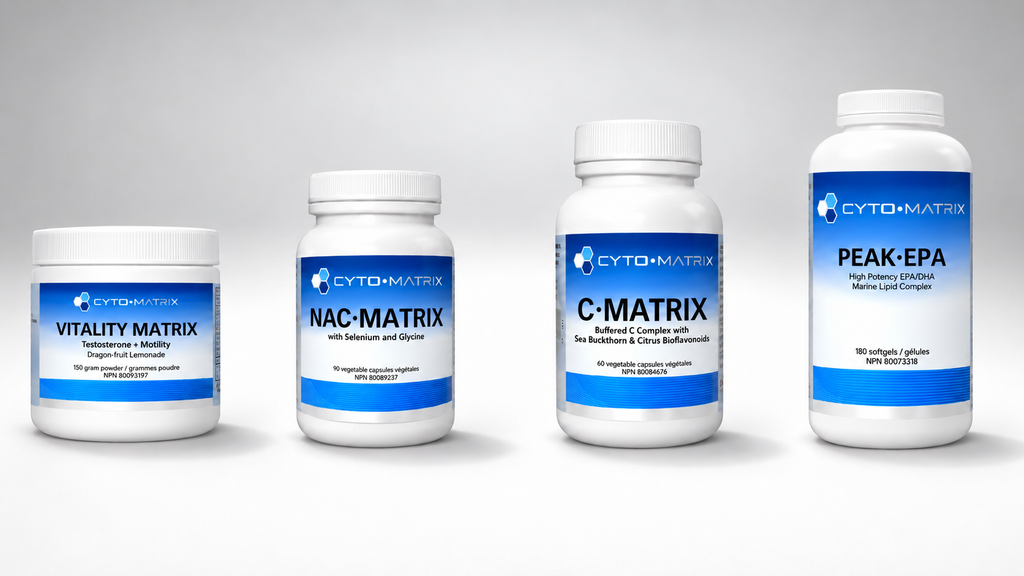
Acubalance has selected four supplements that provide key nutrients at clinically meaningful doses to support sperm count, motility and DNA integrity:
Vitality Matrix — 1 scoop daily
Acetyl-L-carnitine, CoQ10, zinc, selenium, vitamin D and additional nutrients.
NAC·Matrix — 1 capsule daily
600 mg NAC for antioxidant support.
Peak EPA — 1 softgel daily
700 mg EPA + 350 mg DHA omega-3s.
C·Matrix — 1 capsule daily
500 mg vitamin C for antioxidant protection.
For men trying to conceive naturally or through IUI or IVF, we recommend starting 3 to 6 months before conception whenever possible.
Available at Acubalance Wellness Centre or online through our Fullscript dispensary.
Shop the Male Fertility Supplement Protocol
Support Sperm Health
Acubalance has put together a targeted male fertility supplement collection using key nutrients at clinically meaningful doses to support sperm count, motility and DNA integrity.
The collection includes nutrients such as acetyl-L-carnitine, CoQ10, NAC, omega-3s, vitamin C, vitamin D, zinc and selenium, selected to support antioxidant protection, mitochondrial function and overall sperm health.
If you are trying to conceive naturally or through IUI or IVF, we recommend starting male fertility support 3 to 6 months before conception whenever possible.